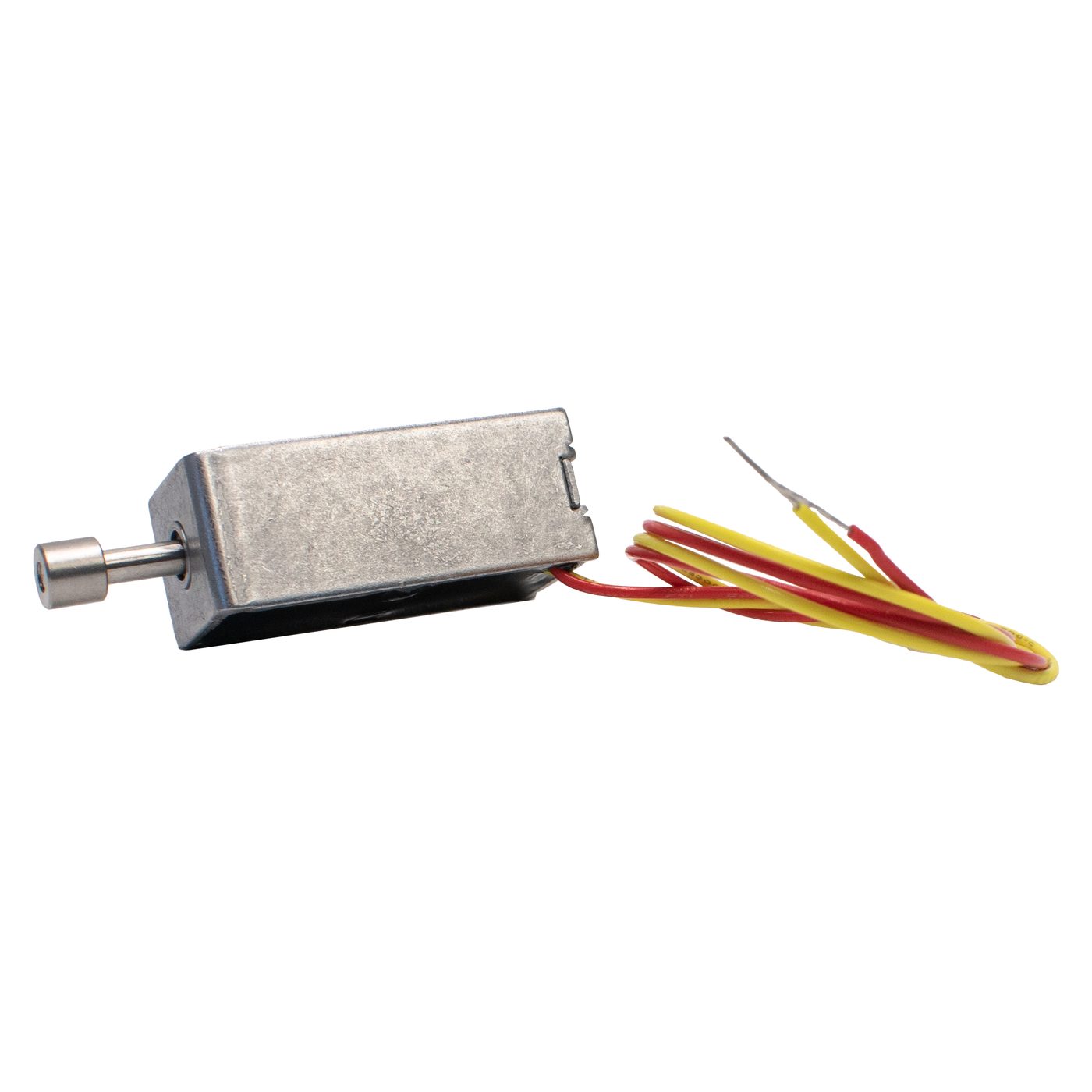
Where this type fits
A permanent magnet retains the plunger after the pulse ends, so the coil draws no power while holding. Built for battery-powered locks, meters and remote equipment.
How it works
Current through the coil produces a magnetic field that pulls the plunger into the air gap. The useful output is a force that rises steeply as the gap closes — which is why the rated force always belongs to a specific stroke, not to the part in general. Latching designs trade package size against that force profile in a different way from the other families, and the comparison table below reflects that.
Models in this family
| Model | Description | Stroke / orifice | Force / pressure | Voltage |
|---|---|---|---|---|
| X40180 | Square Latching Solenoid | 4 mm | up to 40 N | 6 / 12 V DC |
| KS1139L/S | Bi-Directional Latching Solenoid | 5 mm curve range | — | — |
| KS0521L/S | Bi-stable latching KS0521L/S | — | — | — |
| KS1225L/S | Bi-stable latching KS1225L/S | — | — | — |
| KS1564L/S | Bi-stable latching KS1564L/S | — | — | — |
| KS1895L/S | Bi-stable latching KS1895L/S | — | — | — |
| KY0730L/S | Self-holding KY0730L/S | — | — | — |
| KY0735L/S | Self-holding KY0735L/S | — | — | — |
| KY0940L/S | Self-holding KY0940L/S | — | — | — |
| KY0951L/S | Self-holding KY0951L/S | — | — | — |
| KY1037L/S | Self-holding KY1037L/S | — | — | — |
What decides the choice
Stroke versus force
Long stroke with high force means a large frame. Fix the stroke first, then see what force is achievable in the space you have.
Duty cycle
Continuous operation needs a coil sized for the temperature rise, not the peak force. Most field failures start here.
Supply and drive
Available voltage, inrush behaviour and whether the drive is a relay, MOSFET or H-bridge all change the coil design.
Environment
Ambient temperature, humidity, dust and vibration determine sealing and insulation class.
What can be customised
- Coil winding: voltage, resistance, power and insulation class
- Stroke and force profile for your mechanism
- Termination: fly leads, PCB pins, connector or terminal block
- Mounting pattern, plunger end form and return spring
- Sealing, encapsulation and acoustic damping