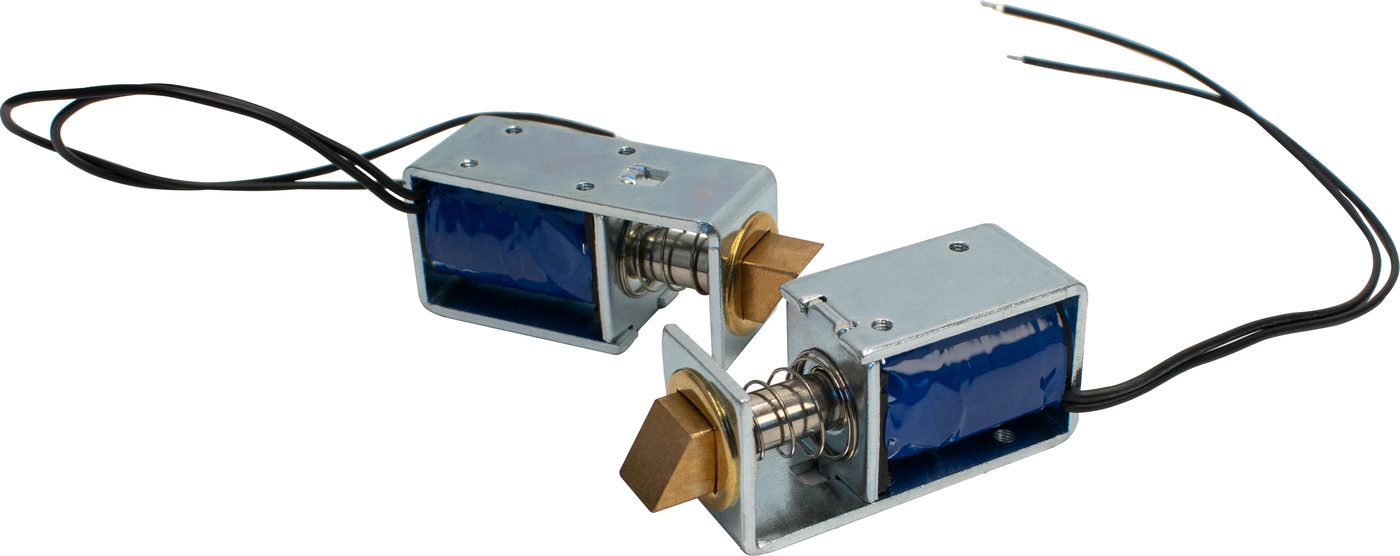
Start from the mechanism, not the catalogue
Most selection guides open with a product table. That ordering is wrong, and it costs people weeks. The solenoid sits inside a mechanism, and the mechanism has already decided most of the answer before anyone opens a datasheet: how far something must move, how hard it must push, how often it cycles, and how much room is left after everything else claims its space.
So before comparing a single part number, write those four things down. If your team cannot fill them in, the specification is not ready. No amount of part-to-part comparison will rescue a spec that does not exist. We see this a lot with lock designs: someone picks a nice-looking latching solenoid from a marketplace listing, builds the prototype around it, and only then measures the bolt travel. The bolt needs 9 mm. The solenoid does 5 mm. Back to square one.
Start with the mechanism. The catalogue comes later, and it goes faster because of it.
The four numbers you actually need
1. Stroke, measured at the worst case
Stroke is the distance the plunger travels from rest to the point where the work is done. Measure the worst case, never the nominal. A cabinet lock bolt that must clear a strike plate needs plate thickness, plus engagement depth, plus about a millimetre of margin. If the drawing says 6 mm nominal, your real requirement may be 8 mm. That gap between nominal and worst case is where most first prototypes fail.
2. Force at the end of that stroke
Force is not one number. A solenoid makes its highest force when the air gap is closed and its lowest force when the gap is fully open, which is exactly the moment your load is heaviest if a spring is involved. The figure you need is the force available at the end of your stroke against the load the mechanism presents there. If a datasheet quotes a single newton figure without a stroke condition, treat it as marketing. Our article on force versus stroke goes deep on this.
3. Duty cycle
How long the coil is energised as a proportion of the total cycle. Duty decides the coil more than force decides the frame. Two parts with identical frames can differ by a factor of two in continuous force purely because of how their coils are rated. The duty cycle guide covers the arithmetic and the temperature behaviour behind it.
4. Envelope, including the annoying parts
The volume available, including connector overhang and the plunger's travel into free air. Designs die on the last 3 mm of cable bend radius more often than they die on force. Leave room for the wire to exit without tension, or specify the exit direction when you order.
Match the family to the motion
| If the mechanism needs | Consider | Because |
|---|---|---|
| Push and pull, short stroke | Push-pull, open frame | Lowest cost per newton in a compact frame |
| Long stroke with high force | Tubular | Round housing gives the best force per volume at long gaps |
| Hold position with no power | Latching, bi-stable | Permanent magnet holds after the pulse ends |
| Rotation through a fixed angle | Rotary | Coil energy converts directly into shaft angle |
| Locking a door or panel | Solenoid lock assembly | Bolt, housing and alignment solved as one part |
| Fluid or gas control | Solenoid valve | Seal and orifice matched to the medium |
Two of these can be true at once. A tubular latching solenoid is a real, common part: long stroke plus zero holding power, both in one frame. That combination trips people up sometimes, but it is not a contradiction. It just means the mechanism needs both, and the design has to deliver both.
Budget matters too, and it helps to know the rough order of it. Indexed to open-frame parts, a typical factory price ladder looks like this:
The premium on latching and rotary types is not margin greed. Magnet stacks, pulse-rated coils and the extra build steps they need genuinely cost money. What you get back is the energy argument, which the latching comparison article works through with real numbers.
Check duty before you check force
A coil oversized for its duty cycle runs hot, and heat is what ends a solenoid's life. Before you accept any force figure, ask two questions: what duty cycle was it measured at, and what temperature rise did the supplier record at that duty. A part quoted at 90 N with no duty condition attached is a part that will disappoint someone, and it is usually the person who signed the purchase order.
At 25 °C ambient, a coil continuously energised at rated power reaches roughly 60 to 80 °C above ambient at equilibrium. With class B insulation rated at 130 °C, that leaves almost no margin inside a warm enclosure. If your application holds for long periods, either size the coil down and accept a slower stroke, or move to a latching part and stop paying for hold current altogether.
Environment and life: the questions buyers forget
Three questions almost never appear in the first enquiry, and all three have killed field programs.
Dust and lint. An open-frame plunger is a moving hole in the housing. Laundry machines, textile equipment and anything near fabric will pack that gap with fibre. If the environment is dirty, you want a sealed or tubular frame, or a wiper and a maintenance schedule.
Corrosion. Plating choices that survive indoor showroom air fail in coastal salt fog. If the product ships to a coastal market, say so in the enquiry. Zinc-nickel plating costs a little more and answers the problem before it starts.
Cycle life at real load. Life ratings quoted at no load can be an order of magnitude higher than life at your load, because impact velocity at the end stop is what wears the stop washer and the plunger tip. Ask for the test condition, not just the number of cycles.
Validate with a sample, not a spreadsheet
Spreadsheets get you a shortlist. Only a sample on your mechanism settles the selection, because only the sample shows you the things nobody models: the click of the plunger seating, the rattle in the bracket at your natural frequency, the way the cable routes when the enclosure closes.
Our standard process is a two-step sample: first a standard part from the catalogue families to validate the physics, then a configured variant once the mechanism proves out. Jumping straight to a custom build before a standard part has proven the concept usually means paying twice, because the custom dimensions inherit every mistake the prototype made.
If you already have the four numbers written down, send them over. A short email with stroke, force at stroke, duty and envelope gets a concrete recommendation back within two working days, including the parts we would not choose and why.
Frequently asked questions
How do I calculate what force rating I need?
Add the load your mechanism presents at the end of the stroke, then add 30 to 50 percent margin for spring tolerance, friction variation and wear. For a cabinet lock with a 4 N bolt spring, spec around 6 N at the end of stroke. Never size to the nominal load.
What is the difference between push and pull solenoids?
The working surface. A push solenoid drives the plunger outward when energised; a pull solenoid draws a load toward the frame. Many open-frame parts do both, with the plunger exposed on both ends. The choice follows your mechanism's geometry, not the coil.
Can one solenoid work on both AC and DC?
Not the same part. AC solenoids use shaded poles and laminated frames to cope with the alternating field, and they run hotter. DC parts are simpler and quieter. If your supply is AC, either rectify it for a DC coil or pick a purpose-built AC part.
How long do solenoids last?
At rated load and correct duty, mechanically from one to ten million cycles depending on the family and the impact management in the design. The honest number depends on your load and end-stop arrangement, so ask for the life test condition, not just the cycle count.
Do you offer custom stroke and force combinations?
Yes. Stroke, force and coil are all configurable within a frame family. Most custom projects start from a standard frame with a wound-to-order coil, which keeps tooling cost near zero and lead time around three to four weeks.